
Graphic design and photography are closely interconnected disciplines that work together to create effective visual…
Art Movements Every Designer Should Know
Graphic design does not exist in isolation. It is the product of centuries of artistic evolution, shaped by cultural, technological, and philosophical shifts. Many of the visual principles, styles, and techniques used in modern graphic design originate from historical art movements. Understanding these movements allows designers to develop deeper visual literacy, expand creative possibilities, and apply established visual strategies effectively (Meggs & Purvis, 2016).
Each art movement introduced new approaches to composition, color, typography, abstraction, and communication. These innovations continue to influence branding, digital interfaces, typography, and visual identity today (Hollis, 2001).
For designers, knowledge of art movements is not merely historical—it is practical.
Classical Art: The Foundation of Visual Structure
Classical art, originating in ancient Greece and Rome, established fundamental principles of proportion, symmetry, and balance. Artists used mathematical relationships to create harmonious compositions that reflected natural order and human perception (Gombrich, 1995).
These principles remain essential in modern design, influencing:
- Layout structure
- Typography proportion
- Visual hierarchy
Classical art introduced systematic approaches to visual organization.
These principles provide the foundation of modern composition (Arnheim, 1974).
Renaissance: Perspective and Human-Centered Design
The Renaissance revolutionized visual representation by introducing linear perspective, anatomical accuracy, and mathematical composition. Artists such as Leonardo da Vinci developed techniques to create realistic spatial depth (Meggs & Purvis, 2016).
Renaissance innovations influence modern design through:
- Grid systems
- Spatial hierarchy
- Realistic depth
- Balanced composition
These techniques improve visual clarity and communication effectiveness (Ware, 2013).
The Renaissance established scientific approaches to visual design.
Baroque: Drama, Contrast, and Emotional Impact
The Baroque movement emphasized dramatic contrast, movement, and emotional intensity. Artists used strong light-dark contrast, known as chiaroscuro, to create visual drama (Gombrich, 1995).
Baroque principles influence modern design through:
- High contrast layouts
- Dramatic lighting effects
- Dynamic compositions
These techniques enhance visual impact and emotional engagement.
Baroque art demonstrated the expressive power of visual contrast.
Romanticism: Emotion and Individual Expression
Romanticism emphasized emotional expression, imagination, and individual creativity. Artists focused on atmosphere, storytelling, and subjective experience (Arnheim, 1974).
This movement influenced modern design through:
- Expressive illustration
- Emotional branding
- Visual storytelling
Romanticism expanded the emotional possibilities of visual communication.
Design became more expressive.
Impressionism: Light, Color, and Visual Perception
Impressionism focused on capturing light, color, and visual perception rather than precise detail. Artists explored how color and light interact visually (Gombrich, 1995).
Impressionist principles influence modern design through:
- Color experimentation
- Atmospheric effects
- Visual mood creation
Designers use color to communicate emotion and tone (Ware, 2013).
Impressionism deepened understanding of visual perception.
Cubism: Abstraction and Multiple Perspectives
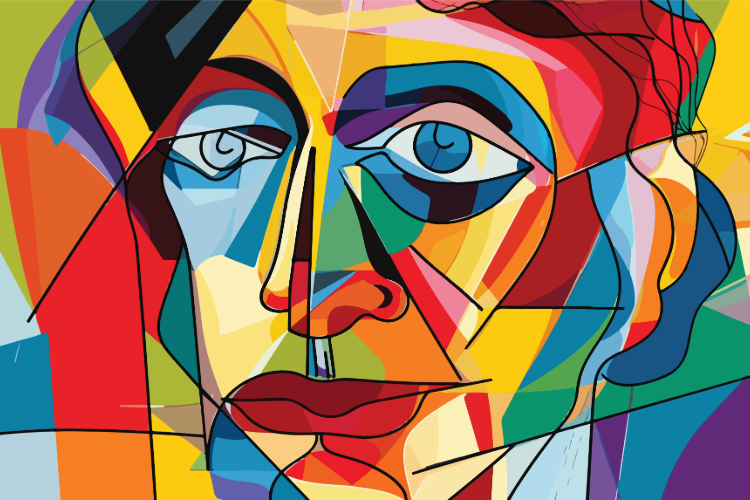
Cubism, pioneered by Pablo Picasso and Georges Braque, broke objects into geometric forms and presented multiple perspectives simultaneously (Meggs & Purvis, 2016).
Cubism influenced modern design through:
- Geometric abstraction
- Fragmented composition
- Experimental layout
Cubist principles are visible in modern logo design and abstract visual identity.
Cubism expanded visual representation beyond realism.
Futurism: Movement and Technological Energy
Futurism emphasized motion, speed, and technological progress. Artists used dynamic lines and energetic compositions to convey movement (Hollis, 2001).
Futurism influenced modern design through:
- Motion graphics
- Dynamic typography
- Energetic layouts
This movement connected visual design with modern technology.
Futurism emphasized visual energy.
Bauhaus: Functional Design and Minimalism
The Bauhaus movement revolutionized design by emphasizing simplicity, geometry, and functionality. Designers rejected unnecessary decoration and focused on clarity (Droste, 2002).
Bauhaus introduced:
- Sans-serif typography
- Grid systems
- Minimalist design
These principles remain central to modern graphic design (Meggs & Purvis, 2016).
Bauhaus transformed design into functional communication.
Swiss Design: Clarity and Grid-Based Layout
Swiss Design, also known as the International Typographic Style, emphasized clarity, order, and objective communication (Samara, 2007).
Swiss Design introduced:
- Grid systems
- Clean typography
- Minimal layouts
These principles improve readability and usability.
Swiss Design shaped modern digital interface design.
Clarity became the priority.
Modernism: Simplicity and Universal Communication
Modernism emphasized simplicity, rational structure, and functional communication. Designers used minimal elements to communicate clearly (Hollis, 2001).
Modernism influenced:
- Corporate branding
- Interface design
- Typography
Modernist principles reduce cognitive load and improve comprehension (Ware, 2013).
Modernism established design as systematic communication.
Postmodernism: Expression and Visual Diversity
Postmodernism rejected strict modernist rules and embraced complexity, experimentation, and cultural diversity (Poynor, 2003).
Postmodern design includes:
- Experimental typography
- Layered composition
- Expressive visuals
Postmodernism expanded creative freedom in design.
Design became more expressive and subjective.
Minimalism: Simplicity and Clarity
Minimalism focuses on reducing design to essential elements. It removes unnecessary visual information to improve clarity (Lidwell et al., 2010).
Minimalist design emphasizes:
- Clean layouts
- Simple typography
- Clear hierarchy
Minimalism improves usability and communication effectiveness.
Less visual complexity improves cognitive processing.
Contemporary Digital Design: Integration of Historical Principles
Modern digital design integrates principles from multiple art movements.
Designers combine:
- Classical proportion
- Renaissance composition
- Bauhaus functionality
- Swiss clarity
- Postmodern expression
This integration allows designers to create effective and engaging visual communication (Meggs & Purvis, 2016).
Modern design is built on historical foundations.
The Importance of Art Movements for Designers
Understanding art movements helps designers:
- Develop visual literacy
- Expand creative approaches
- Understand visual communication principles
- Apply effective design strategies
Art history provides a framework for design innovation.
Design evolves through historical influence.
Knowledge enhances creative capability.
Conclusion
Art movements have shaped the evolution of graphic design by introducing new approaches to composition, typography, abstraction, and communication. From Classical proportion to Bauhaus functionality and Postmodern expression, each movement contributed essential principles that continue to influence modern design.
Graphic designers are part of this historical continuum.
Understanding art movements allows designers to create work that is both innovative and grounded in proven visual principles.
Design is not separate from art history. It is the continuation of it.
Knowledge of art movements strengthens both creativity and communication.
References
Arnheim, R. (1974). Art and visual perception: A psychology of the creative eye. University of California Press.
Droste, M. (2002). Bauhaus, 1919–1933. Taschen.
Gombrich, E. H. (1995). The story of art (16th ed.). Phaidon Press.
Hollis, R. (2001). Graphic design: A concise history (2nd ed.). Thames & Hudson.
Lidwell, W., Holden, K., & Butler, J. (2010). Universal principles of design (Rev. ed.). Rockport Publishers.
Meggs, P. B., & Purvis, A. W. (2016). Meggs’ history of graphic design (6th ed.). Wiley.
Poynor, R. (2003). No more rules: Graphic design and postmodernism. Laurence King Publishing.
Samara, T. (2007). Grid systems: Principles of organizing type. Rockport Publishers.
Ware, C. (2013). Information visualization: Perception for design (3rd ed.). Morgan Kaufmann.

Related Posts


This Post Has 0 Comments