
Graphic design and photography are closely interconnected disciplines that work together to create effective visual…
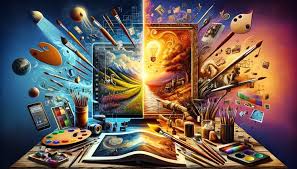
Visual Arts in the Age of Digital Media
The digital revolution has transformed how visual art is created, distributed, and experienced. With the emergence of computers, software, and digital platforms, artists and designers now work in environments that extend beyond physical materials such as canvas and paint. Digital media has expanded the possibilities of visual expression, enabling artists to combine traditional artistic principles with technological innovation. Despite these technological changes, the fundamental elements of visual art—line, color, shape, texture, space, and composition—remain central to effective visual communication (Lupton & Phillips, 2015; Ware, 2013).
Visual arts in the digital age represent the integration of artistic creativity with technological capability.
The Transition from Traditional to Digital Visual Arts
Traditional visual art relied on physical tools such as brushes, pencils, and sculpting materials. Digital visual art uses software tools such as graphic design programs, digital painting applications, and 3D modeling software (Meggs & Purvis, 2016).
This transition has allowed artists to:
- Create art more efficiently
- Edit and refine work easily
- Experiment with unlimited visual possibilities
Digital tools enhance creative flexibility.
Technology expands artistic potential.
Digital media provides new creative opportunities.
Digital Tools and Creative Expression
Digital media provides artists with powerful tools that enhance creative control. Software applications allow precise manipulation of visual elements, enabling artists to experiment with color, texture, lighting, and composition (Lupton, 2010).
Digital tools allow designers to:
- Adjust colors instantly
- Modify composition easily
- Apply visual effects
- Create complex visual structures
These capabilities improve efficiency and creative exploration.
Digital tools support artistic experimentation.
Technology enhances artistic precision.
Visual Elements Remain Essential in Digital Design
Despite technological advancements, digital art still relies on traditional visual elements and design principles. Line, color, shape, space, and texture remain essential for creating effective visual communication (Wong, 1993).
Digital tools do not replace artistic principles.
They enhance the application of those principles.
Design effectiveness depends on visual fundamentals.
Technology supports artistic execution.
Fundamental principles remain essential.
Digital Media and Visual Communication
Digital visual art plays a central role in modern communication. Websites, social media, advertising, and digital interfaces rely on visual design to communicate information effectively (Meggs & Purvis, 2016).
Digital visual communication includes:
- Website design
- Social media graphics
- User interface design
- Digital advertising
Visual communication improves message clarity.
Design enhances information delivery.
Digital media enables global communication.
Accessibility and Global Distribution
Digital media allows visual art to reach global audiences instantly. Online platforms enable artists to share work with viewers worldwide (Manovich, 2001).
Digital distribution increases:
- Accessibility
- Audience reach
- Cultural exchange
Artists can communicate across geographical boundaries.
Digital media democratizes artistic expression.
Technology expands artistic visibility.
Interactive and User-Centered Visual Design
Digital media introduced interactive visual experiences. Unlike traditional art, digital design often responds to user interaction (Norman, 2013).
Interactive design includes:
- User interfaces
- Mobile applications
- Interactive websites
Designers must consider usability and user experience.
User-centered design improves communication effectiveness.
Interaction enhances visual engagement.
Digital design responds to human behavior.
Motion Graphics and Time-Based Visual Arts
Digital media introduced motion graphics, which incorporate movement into visual communication. Motion adds a temporal dimension to visual art (Meggs & Purvis, 2016).
Motion graphics are used in:
- Animation
- Video design
- User interface transitions
Movement enhances attention and communication effectiveness.
Motion strengthens visual storytelling.
Digital media expands visual possibilities.
Time becomes a design element.
Digital Photography and Image Manipulation
Digital photography allows artists to capture and manipulate images using digital tools. Image editing software enables precise control over visual elements (Manovich, 2001).
Artists can adjust:
- Color
- Contrast
- Lighting
- Composition
Digital editing enhances visual clarity.
Technology expands photographic creativity.
Digital photography enhances visual storytelling.
Photography becomes more flexible.
Three-Dimensional (3D) Digital Art
Digital technology allows artists to create three-dimensional visual environments using modeling software. 3D art simulates physical space digitally (Ware, 2013).
3D design is used in:
- Animation
- Video games
- Virtual reality
Three-dimensional design enhances realism.
Digital environments simulate physical reality.
Technology expands spatial design.
3D art enhances immersive experiences.
Visual Identity and Branding in Digital Media
Digital media plays a critical role in brand identity. Visual identity systems are applied across websites, social media, and digital platforms (Lupton & Phillips, 2015).
Digital branding includes:
- Logos
- Typography
- Color systems
- Interface design
Consistency strengthens brand recognition.
Digital media enhances identity communication.
Visual identity becomes digitally integrated.
Design supports brand communication.
Cultural and Social Impact of Digital Visual Arts
Digital visual art reflects contemporary culture and social change. Artists use digital media to communicate social messages and cultural narratives (Manovich, 2001).
Digital art contributes to:
- Cultural expression
- Social communication
- Public awareness
Technology enhances cultural storytelling.
Digital art reflects modern society.
Visual communication influences culture.
Art evolves with technology.
Cognitive and Perceptual Considerations in Digital Design
Digital design must consider how humans perceive and process visual information. Effective digital design reduces cognitive load and improves comprehension (Ware, 2013).
Designers use:
- Visual hierarchy
- Contrast
- Clarity
These techniques improve usability.
Design supports cognitive processing.
Visual clarity enhances understanding.
Digital design supports perception.
Challenges and Responsibilities of Digital Artists
Digital artists must balance creative expression with technical and ethical considerations. Designers must ensure visual communication is clear, accessible, and responsible (Norman, 2013).
Designers must consider:
- Accessibility
- Cultural sensitivity
- User experience
Digital art has social responsibility.
Design influences perception and behavior.
Digital artists shape visual culture.
Design carries ethical implications.
Conclusion
Visual arts in the age of digital media represent the integration of traditional artistic principles with modern technology. Digital tools expand creative possibilities while preserving the fundamental elements of visual design.
Digital media enhances artistic expression, communication, and accessibility.
Technology transforms how art is created and experienced.
However, effective digital art still relies on classical visual principles.
Digital tools enhance creativity—but artistic principles guide it.
Visual arts continue to evolve, but their purpose remains the same: to communicate ideas, express meaning, and shape human experience.
Digital media expands the reach of visual storytelling.
Art continues to evolve with technology.
References
Lupton, E. (2010). Thinking with type: A critical guide for designers, writers, editors, and students (2nd ed.). Princeton Architectural Press.
Lupton, E., & Phillips, J. C. (2015). Graphic design: The new basics (2nd ed.). Princeton Architectural Press.
Manovich, L. (2001). The language of new media. MIT Press.
Meggs, P. B., & Purvis, A. W. (2016). Meggs’ history of graphic design (6th ed.). Wiley.
Norman, D. A. (2013). The design of everyday things (Revised and expanded ed.). Basic Books.
Ware, C. (2013). Information visualization: Perception for design (3rd ed.). Morgan Kaufmann.
Wong, W. (1993). Principles of form and design. John Wiley & Sons.

Related Posts


This Post Has 0 Comments